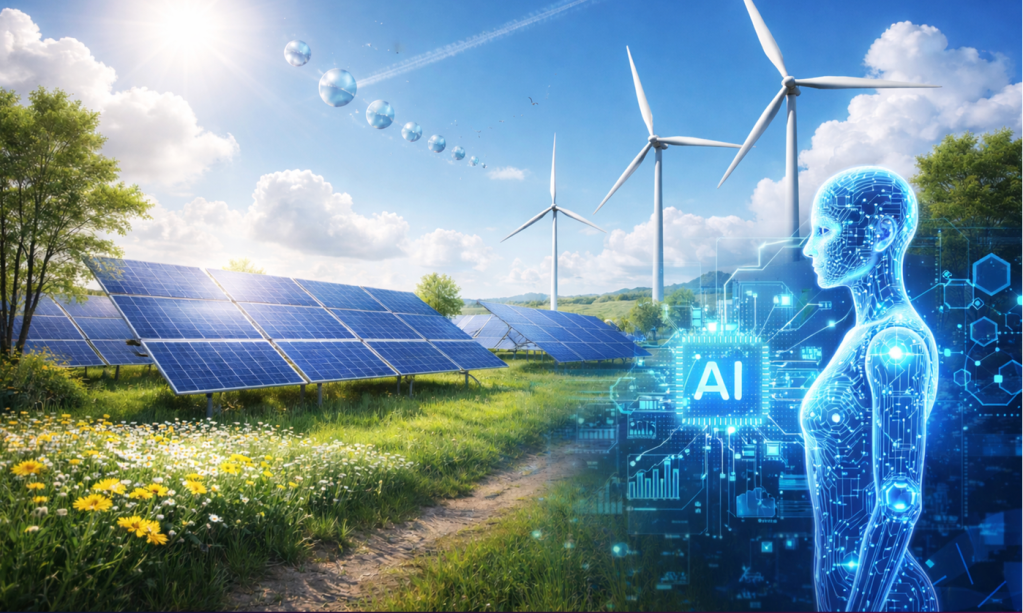
Almost everything, from success at individual level to progress of nations, are measured in terms of growth – economic growth. Is it possible, as proposed by The European Green Deal, to decouple economic growth from overuse of the Earth’s resources, and can Artificial Intelligence (AI) be a catalyst for achieving this?
By Morten Dæhlen
Economic growth has historically been tied to resource extraction. Increased production has required more energy, more materials, more land, and ultimately given more emissions, which have resulted in change of climate and nature with severe consequences for the life on Earth. If we are serious about sustainability, the link between growth and the overuse of Earth’s resources must be broken.
Artificial Intelligence could become one of the most powerful tools ever developed to decouple prosperity from environmental degradation. Hence, help humanity consume fewer resources from the Earth than the Earth itself can recreate?
Smarter Energy Systems – managing the Renewable Age
Transitioning from fossil fuels to renewables is, of course, an engineering challenge, but it is also a huge data challenge.
Wind and solar are variable and decentralised energy resources. Balancing supply and demand in real time requires predictive modelling and adaptive control systems. AI can forecast weather-driven generation patterns, optimise grid stability, and coordinate distributed energy resources. The International Energy Agency emphasises that digital technologies are critical for integrating renewables at scale. With AI, intermittency becomes more manageable.
Precision Agriculture – producing More with Less
Agriculture consumes land, water, and chemicals on a massive scale. AI-powered sensors, drones, and predictive analytics allow farmers to apply water, fertiliser, and pesticides exactly where needed, sometimes down to individual plants.
The result is higher yields, lower chemical runoff, and reduced emissions. Growth in food production no longer has to mean proportional growth in resource use.
Reinventing Infrastructure and Mobility
AI can optimise infrastructure across its entire lifecycle, e.g. generative design can reduce material use in construction, predictive maintenance can extend the lifetime of assets, and real-time monitoring can reduce operational energy waste.
In transport, AI improves traffic flow, optimises shipping routes, enhances aircraft efficiency, and supports electric mobility systems. Across land, sea, and air, fewer resources can move people and goods. Can we obtain less movement of everything while still building and maintaining prosperity? AI can ensure that resource-efficiency actions become systemic across infrastructure and mobility systems.
Preventive Healthcare – Lower Footprint, Better Outcomes
Healthcare systems are resource-intensive. AI enables earlier diagnosis, predictive analytics, and telemedicine. By preventing disease escalation, AI reduces the need for high-intensity treatments and hospital stays, lowering both costs and carbon footprints. Smarter systems are both cheaper and cleaner, but huge investments are required to get there.
AI as a Scientific Force Multiplier
AI is accelerating scientific discovery. Machine learning models can simulate ecological systems, forecast biodiversity loss, and model atmospheric dynamics with unprecedented precision. AI-driven materials science is speeding up the discovery of high-capacity batteries, carbon capture materials, and new superconductors essential for a post-carbon economy. The faster we develop sustainable technologies, the faster growth can shift away from extensive resource extraction.
A Digital Nervous System for the Planet
AI transforms satellite imagery, radar signals, and sensor networks into actionable environmental intelligence. It can detect illegal deforestation, monitor glacier melt, forecast floods, and provide early warning for extreme weather events. Instead of reacting to environmental collapse, societies can anticipate and prevent it. A shift from reactive to proactive stewardship is fundamental for decoupling growth from destruction.
The Equity Dimension
The decoupling of growth from the overuse of resources must be global. Among other things AI-powered learning platforms can democratise education and equip underprivileged populations with skills needed in a green economy. If only wealthy nations benefit from AI-enabled efficiency, inequality will widen, and sustainability goals will fail. Digital inclusion is a prerequisite for generating a sustainable future for all.
Conditions for Real Decoupling
AI will not automatically deliver sustainability. At least these three conditions are essential:
- Energy alignment: Intelligence has to be moved to the edge (away from data centres), and AI infrastructure must run on less energy and new renewable energy.
- Policy direction: Incentives must reward AI applications that reduce emissions and overuse of resources, most likely tax regimes on digital resources has to be implemented to steer consumption in the right direction.
- Measurement: Through global cooperation, we must quantify AI’s systemic impact, both negative and positive. This is necessary to really understand what works and what to do.
The direction of AI will depend on how technology develops, but governance is equally important.
The Twin Transition
A sustainable future for all requires a green transition of society – a transition to an age where humanity’s consumption of resources is in balance with what the Earth can provide. The AI revolution ensures that the digital transition of society continues at full speed. The twin transition is about how the dynamics and strength of the digital transition affect the green transition, and how these two transitions mutually influence each other.
AI is a heavy resource-intensive industry, but also has the potential of being a catalyst for the green transition. AI, as of today, is therefore at the core of what the twin transition is about. AI has made twin transition policies and strategies even more important, “The Twin Transition Century; The role of digital research for a successful green transition of society”.
Sustainable economic growth?
True decoupling means increasing economic value while stabilising and eventually reducing material throughput and emissions. AI can enable better matching of supply and demand, predictive maintenance instead of replacement, digital services replacing physical goods, optimised logistics minimising waste and accelerated clean-tech discovery.
But there is also a warning. If AI is used to increase efficiency in fossil fuel extraction or stimulate hyper-consumption through personalised advertising, it will reinforce the old growth model rather than foster sustainable economic growth.
A Defining Test for Artificial Intelligence
The ultimate test of AI may not be whether it writes better text or predicts markets more accurately. It may be whether it helps humanity achieve sustained prosperity without escalating ecological collapse.
If AI can help us decouple economic growth from the overuse of Earth’s resources, it will not only be a technological revolution – it will be a turning point for our civilisation. This post is closely releated to the post on AI and sustainability.
This post was first published by The Guild 14. April 2026.


Leave a Reply